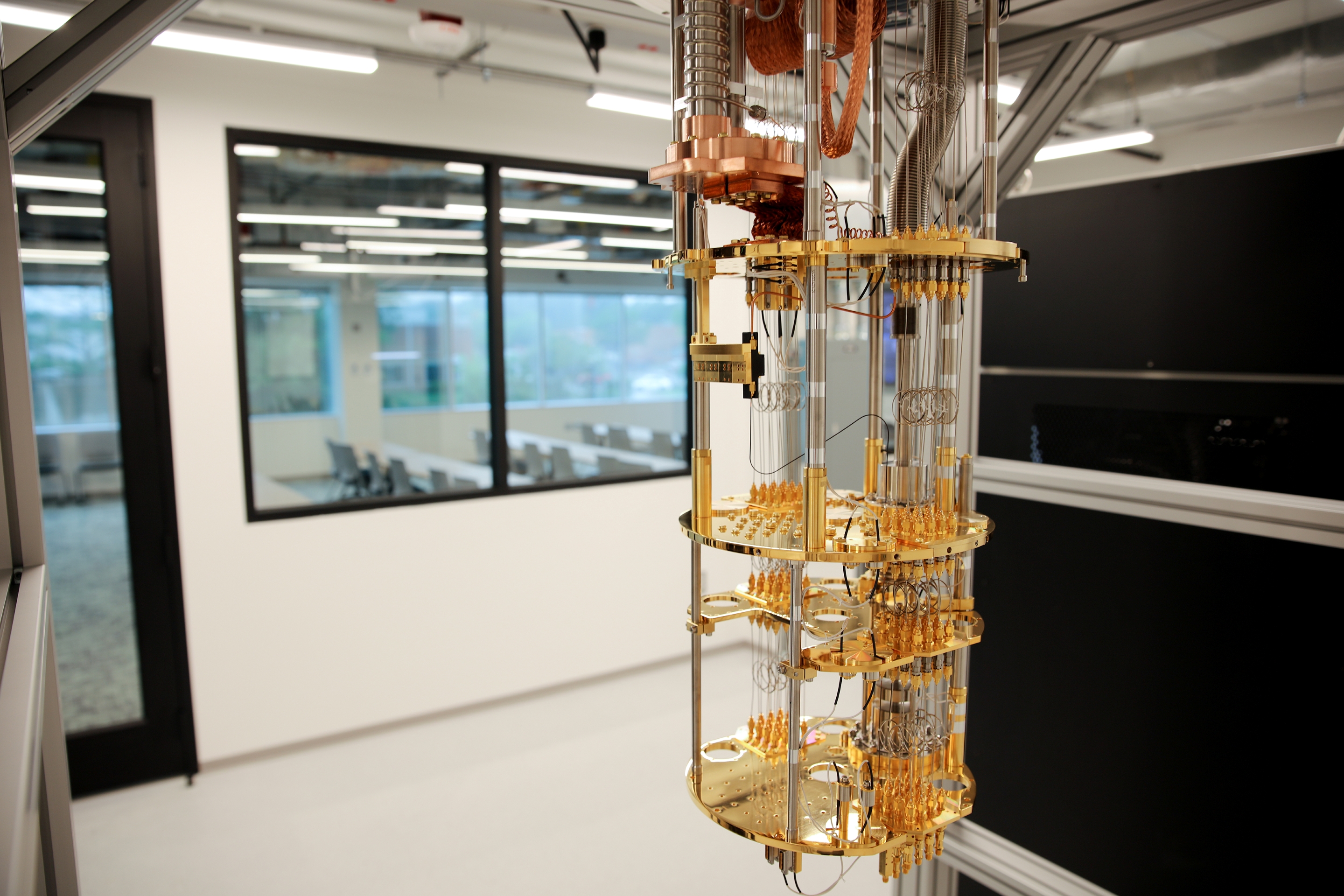
Often called a “chandelier” for its stacked gold tiers, a dilution refrigerator at Microsoft’s College Park center cools a quantum processor to a fraction of a degree above absolute zero. Photo courtesy of Microsoft.
The September ribbon-cutting at Microsoft’s new College Park center marked more than the completion of a commercial fit-out. The adaptive reuse project had transformed vacant office space at the University of Maryland’s Discovery District into a leading-edge quantum research facility.
The project advances the state’s Capital of Quantum initiative — a public-private partnership working to catalyze $1 billion in investment to establish Maryland as a global leader in quantum information science and technology.
To date, six companies have launched or completed plans to open facilities in the Discovery District. But industry experts say the growth of the quantum sector will spread far beyond UMD College Park.
“Maryland is investing in the full quantum technology stack, not just quantum computing but also quantum networking, post-quantum cryptography, quantum sensing, quantum materials,” said Richardo Benn, Deputy Secretary, Division of Innovation and Growth in the Maryland Department of Commerce.
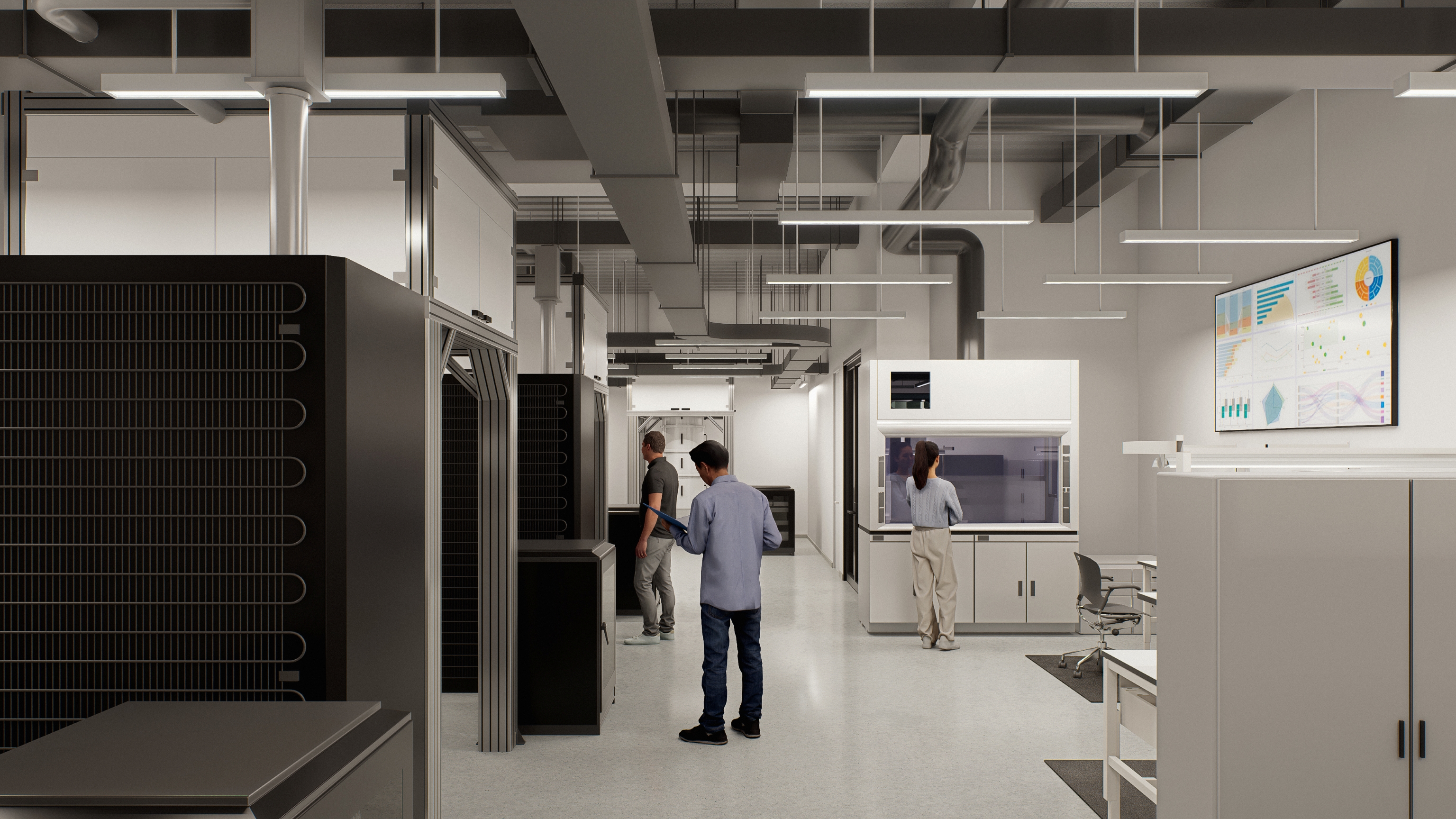
Rendering of Microsoft’s new, 15,000-square-foot quantum computing research center at UMD College Park. Images courtesy of Microsoft.
That is already fueling “a variety of efforts across the state,” including quantum facilities at Johns Hopkins University, JHU Applied Physics Laboratory and NASA Goddard Space Flight Center, Benn said. He expects other quantum facilities could be created to support life sciences in Montgomery County, cryptography at Fort George G. Meade, research and development work at Patuxent River Naval Station, and other locations.
The growing quantum sector presents new opportunities for commercial real estate professionals.
“But tracking real estate and facility needs is challenging because the industry is evolving so quickly,” said Ken Ulman, President of Terrapin Development Company.
Facility requirements will vary by quantum application, but companies generally have three types of space needs, Ulman said.
- Companies manufacturing quantum hardware need slab-on-grade, first-floor, vibration-controlled environments that support the operation of optical tables and other sensitive machinery.
- Software companies can function on higher floors of office buildings if ceiling heights and building infrastructure can support their operations.
- Larger manufacturers — such as the suppliers of lasers, optical tables, vacuum chambers and dilution refrigerators — require large flex/industrial space with vibration controls and clean rooms.
Meeting those needs hinges on having the right kind of property in the right location, and being able to deliver high-tech, unique spaces on very short timelines.
“One of the things we are most proud of is getting ahead of the curve by acquiring the 150,000-square-foot building at 5700 Rivertech Court,” Ulman said.
The building included a small, mothballed data center, a chilled water loop and significant backup generation. It has since become home to five quantum companies, including Microsoft. But creating those tenant spaces still posed challenges.
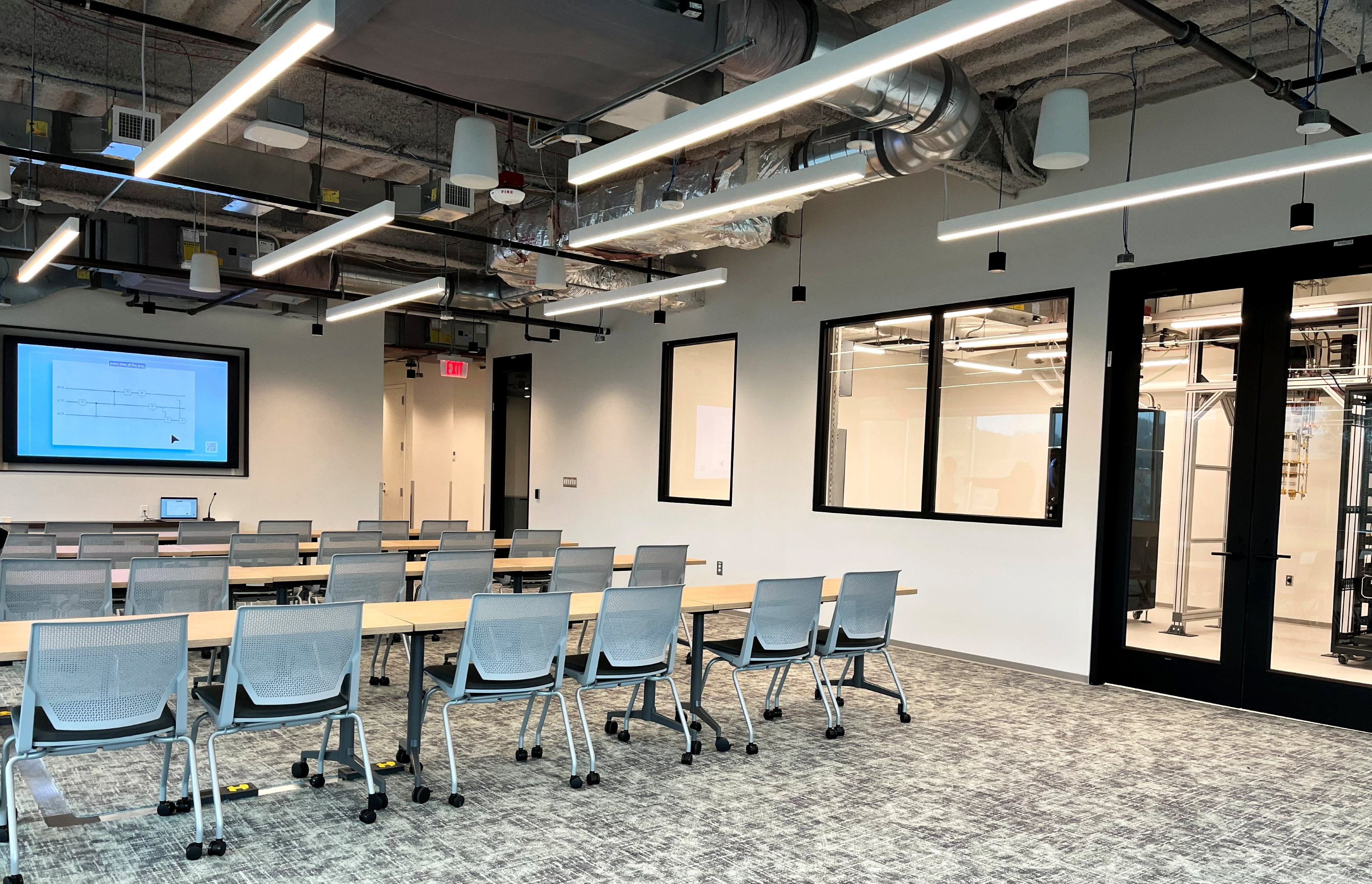
Microsoft’s new quantum computing research facility at College Park’s Discovery District includes a community space where researchers and students can connect. Photo courtesy of Microsoft.
Arium AE, the architect and MEP engineer for Microsoft’s 15,000-square-foot center and Quantum Motion’s 5,185-square-foot lab/offices, had to deliver a unique and technically demanding environment within an office building.
Because nitrogen used in quantum laboratories can displace oxygen, Arium had to separate the labs’ HVAC systems from the building’s system and install oxygen sensors.
Quantum computers contain powerful magnets, “so you have to pay attention to what electronics or metallic items you place near them,” said Kelly Ormsby, Project Manager at Arium AE. “None of the ducts or power systems could be above them, but you also had to install a lot of piping, hosing and wiring that drops down into them.”
Some system requirements couldn’t be fully understood until construction was underway.
Quantum equipment, Ormsby said, is “built specially for the site it is going into and the needs of the group using it. Manufacturers are very protective of such new technology, so there isn’t a cut sheet of system requirements.”
Repurposing vacant office space can help meet quantum companies’ often urgent need for new research and production space, said Brian Frels, Principal at Arium AE. To ensure the Microsoft facility could fit within the existing structure and budget, Arium assembled a team of architects, engineers, structural experts and a cost estimator from the project’s start.
Featured in this article: Arium AE, Maryland Department of Commerce, Terrapin Development Company.