From massive power requirements, specialized air-handling systems, clean rooms, laboratories and reinforced floors to fitouts that can support everything from microchip printers to industrial gantries, manufacturing companies bring lists of hefty and unique requirements to every leasing discussion.
Addressing those needs has required St. John Properties to develop in-depth processes to understand manufacturing operations, and in-house design and construction services to deliver custom industrial spaces. But the effort has given the company access to a robust and growing sector of Maryland’s economy.
Robust requirements
Facilities requirements for manufacturers are both complex and almost always different from one company to the next.
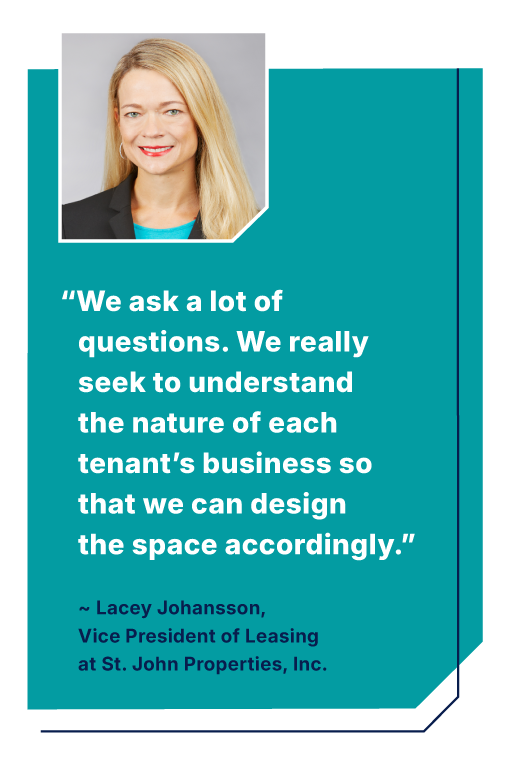
“We ask a lot of questions,” said Lacey Johansson, Vice President of Leasing at St. John Properties. “We really seek to understand the nature of each tenant’s business so that we can design the space accordingly.”
Once the leasing team identifies a desirable space, St. John’s internal design and tenant improvement teams create construction plans, cost out the project and complete the fitout.
 “Our economies of scale are really good,” Johansson said. “We have been working with a lot of the same vendors for a number of years so we get the best price and we move quickly.”
Planning for growth
Settling a manufacturing tenant into a newly leased space, however, isn’t the only thing CRE companies need to do to serve manufacturing companies.
Many small manufacturers have been experiencing significant, sometimes rapid, growth. So manufacturing tenants sometimes need to access more space and aim to accomplish that without going through the very expensive process of moving to a new building.
“For the tenants that I know are on a growth trajectory, I talk to them quarterly. Sometimes, I talk to them monthly so I understand their timeline,” Johansson said.
She tracks upcoming vacancies nearby so “a lot of times when a space opens up, it doesn’t even hit the market because the [manufacturing] tenant takes that space. A lot of our tenants, around BWI particularly, are growing in that warehouse portfolio.”
For example, St. John has a client that leased 1,300 square feet of flex space about five years ago.
“Within probably a year, they were growing and they took 2,600 square feet, then 7,000, then 21,000,” she said. “They ultimately expanded to lease a full building with us.”
In this article: St. John Properties