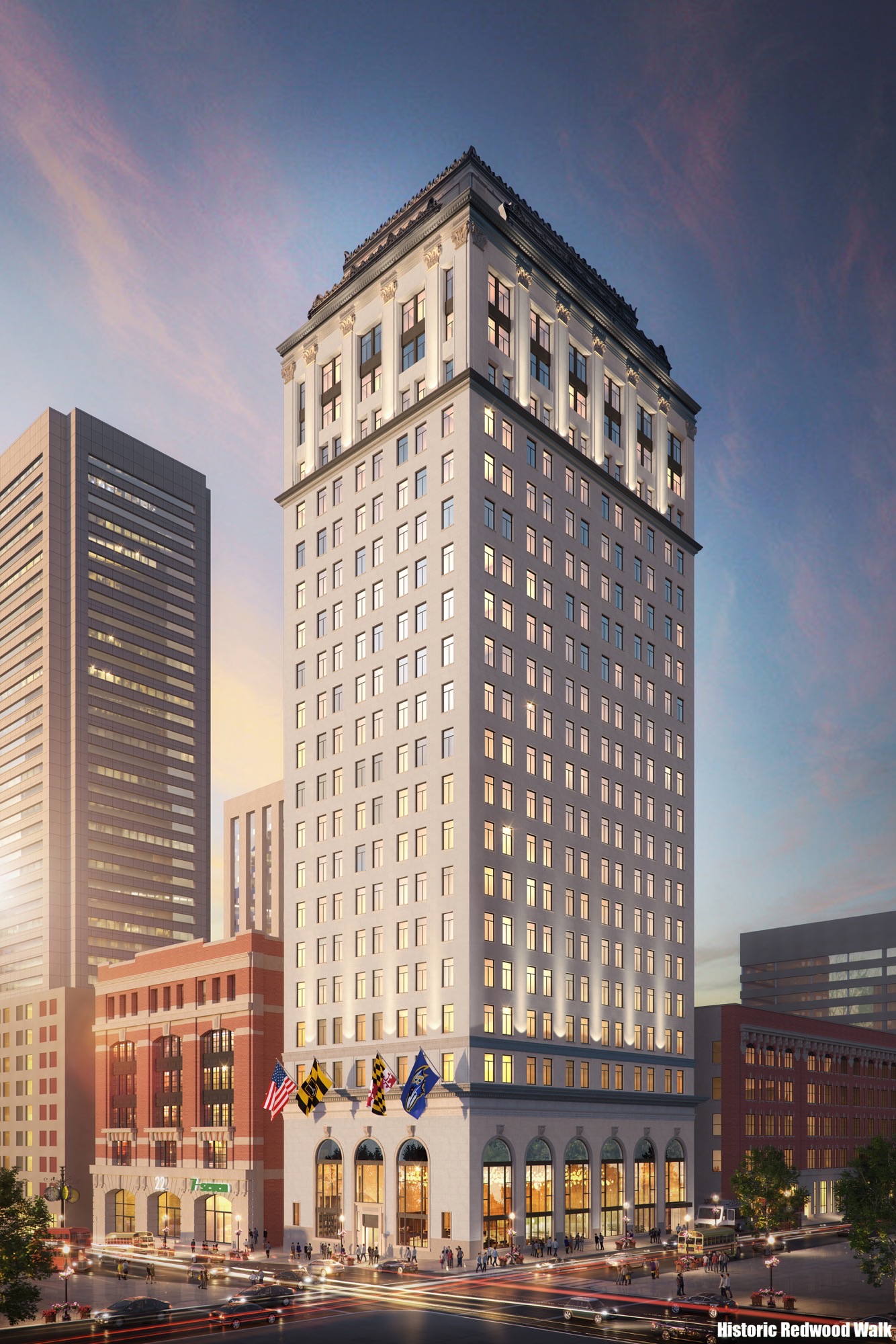
7 E. Redwood Street, a 20-story, 185,000 square foot commercial office building in downtown Baltimore.
The loss of nearly $1 billion in commercial office valuations since 2020 has become the cause of hand-wringing among property owners, investors, and Baltimore City officials who are seeking ways to boost the commercial real estate market and tax revenues.
Research by MacKenzie Commercial Real Estate Services showed the nearly 27 million square feet of space in the city posted a 21 percent vacancy rate and experienced 85,000 square feet of negative absorption in Q2 2026. Baltimore City Center fared even worse with a 28.2 percent vacancy rate.
Demand has diminished specifically for downtown Class B and A commercial office buildings, according to Jim Grieves, a brokerage professional with MacKenzie Commercial Real Estate Services who specializes in the downtown submarket.
One solution, he suggests, is converting more of these assets to residential uses. Such conversions would force tenants in those assets to other buildings which have been shedding tenants in recent years. The problem, however, is that soaring construction prices have made an already expensive proposition cost-prohibitive.
“Some developers have placed conversion plans on hold due to construction pricing and, in my view, owners need assistance in the form of tax incentives, as well as the acceleration of the permit process,” Grieves explained. “We already had a major decrease in the number of workers downtown due to the pandemic, so adding residential units would help retailers and restaurants find their footing with the influx of more people in the city.”
Brad Byrnes, President of Byrnes & Associates, suggests that owners who were able to weather the storm, predominantly caused by the pandemic, “bring unique survival skillsets and now have once-in-a-generation opportunities to buy assets at price points we are not likely to see again.”
He estimates that the emptying out of commercial office buildings – a phenomenon that occurred throughout the country – slashed building prices from 30 to 80 percent.
“Downtown Baltimore comprises one of the largest property tax assessment bases in Baltimore City and the State of Maryland and, when that tax assessment drops, it negatively impacts the funds available to the less fortunate citizens in the city through cuts to much-needed social services programs,” he said.
That is one reason why the city has initiated programs such as Downtown Baltimore Rise and PILOT (payment in lieu of taxes) to encourage developers to jumpstart long-dormant projects, including the Mechanic Theatre site and improvements to the convention center, Byrnes added.
Byrnes is doing his part to help achieve a turnaround in Baltimore City. In addition to remaining an aggressive acquirer of downtown assets, he recently arranged master residential leases at three different projects that will inject more than one thousand upper-class and graduate students from Coppin State and Morgan State University into the area.
“This will bring new vibrancy and energy to downtown, which is desperately needed and will, in turn, help increase property values,” he said.
In this article: Byrnes & Associates and MacKenzie Commercial Real Estate Services.